Aesthetic
Realism
seminar:
The Debate
in Every Person: to Have
More Feeling or Less?
By Michael Palmer
Until
the age of 33, when I began to study Aesthetic
Realism, I thought having more feeling
about something, and showing
it, was a sign of weakness. When I heard
Rudyard Kipling's poem "If," with
its famous beginning, "If you can keep your
head when all about you/ Are
losing theirs," and the conclusion, "you'll
be a Man my son!" I thought,
"yes," that's the way to be!" But, I also
felt dull, half-alive.
Aesthetic Realism shows with clear logic
that the way we'll really take
care of ourselves is to want to know and
have large, accurate feeling
for people and things. And it shows
too what in ourselves that is
against that: our desire to be superior, to
have contempt.
In
his lecture "Aesthetic Realism and Your
Feelings," Eli
Siegel explained, "Every time a person
felt something, no matter what
it was, there was knowledge about
something." Growing up I liked learning
about people who had feeling for others and
a good effect on them.
I remember being moved at age 7 as I heard
the broadcast of President Franklin
Roosevelt's funeral just weeks before the
end of World War ll. He
had guided the country through a terrible
depression and the war, and even
as a boy, I felt bad and wished he could
have lived to see the Allies victory.
I liked reading about those who fought
heroically against fascism, and
was moved at the climax of the documentary
film "Victory in Europe," as
American and Soviet troops, met and embraced
at the Elbe River south of
Berlin. But I was embarrassed
having such feelings and tried
to keep them to myself. "There are some
people," Mr. Siegel explained in
an Aesthetic Realism lesson:
who
feel strength is
in not having too big a feeling--and if they
do have it--to hide it.
Many people feel to be mum is to feel like
an emperor. If we are
less intense than someone else, we think we
are superior.
I
did think I was superior,
especially to my father and older brother who
more readily showed their
emotion. My father tried to have me
excited about things, taking
me to movies, stage shows, the Bronx Zoo, and
baseball games. He
loved the Brooklyn Dodgers and could describe
with zest players he had
a big feeling about, enacting their unique
styles. This included
his favorite pitcher, Freddie Fitzsimmons who
could fool batters by whirling
all the way towards second base before
throwing to the plate. To
my father's enthusiasm I responded by being
cool, feeling like a little
emperor. He would introduce me to
friends and business associates,
and it was clear I preferred being
elsewhere. My parents told their
friends I was "shy," and while I hated myself
for it, I felt driven.
In
a class early in my study with him Mr.
Siegel spoke of shyness, asking
me:
Do
you think
you are troubled by two things that have
been around a long time: timidity
and arrogance? Very often arrogance
one is not sure of comes out
as timidity.
As
I thought about it I
saw I was arrogant; I felt most people were
not worth knowing. And my shame
of this made me timid when I was around
them.
How
Should
We See a Person?
Increasingly,
I
felt desperate to be warmer. Working
as a sportswriter for a radio
station, I became friendly with one of the
newscasters, whom I'll call
Bill Osborne, his wife Laura and their two
young children. While
I knew Bill using marijuana and I worried
about him, I wasn't really interested
in knowing what he felt. His
drug-taking intensified, and he eventually
returned to his home state in the
midwest. Several months later I
was shocked to hear that Bill had died of a
self-inflicted bullet wound.
I went to visit Laura, and even imagined
taking his place with her, but
again I wasn't interested in what she
felt. One day, as I was trying
to cheer her up, reminiscing about the "good
times" we'd had, she suddenly
screamed at me, "You are so damn cool!" I
was stunned and felt horrible.
When
I learned about Aesthetic Realism I began to
understand the fight
in me between feeling more and feeling
less. In one of the first
classes taught by him I attended Mr. Siegel
asked me, "Do you resent the
fact that you have to think of another
person? Do you feel angry
you have to punch the time clock of
emotion?" The answer was yes.
I was so concentrated on what should be
coming to me, I felt I couldn't
afford to have feeling for anyone
else. Mr. Siegel said to me, "Your
mistake is not seeing the full possibility
of a person." And he explained
that to like myself I needed to "see what
another person hopes for."
For
me this was
a revolution! As I began to ask how I
could have a good effect on
people, my life changed, and I had feelings
I never dreamed of. One
of the cherished results is my happy
marriage to Lynette
Abel, the woman I love.
Feeling
For People, Near and Far
In
the lesson I quoted
from, Mr. Siegel said,
One
should ask, what
is one's greatest question. [It] can be put
very simply: Do I have the
best feeling for people and other things
that are not myself, all of them,
near and far?
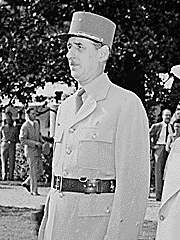 I
speak now about a man whose feeling for his
nation made him one of the
important figures of the last century--French
General and statesman--Charles
De
Gaulle. His insistence that France
was still a fighting
force after the Nazis had taken it over led to
the resistance that eventually
restored France. Then more then a decade
later, he would save that
country from almost certain civil war. In a
1964 lecture, "Drama Is about
Instinct," Mr. Siegel spoke about the feeling
De Gaulle could make for
when he said: I
speak now about a man whose feeling for his
nation made him one of the
important figures of the last century--French
General and statesman--Charles
De
Gaulle. His insistence that France
was still a fighting
force after the Nazis had taken it over led to
the resistance that eventually
restored France. Then more then a decade
later, he would save that
country from almost certain civil war. In a
1964 lecture, "Drama Is about
Instinct," Mr. Siegel spoke about the feeling
De Gaulle could make for
when he said:
Suppose
a person sees
General De Gaulle going down the road in Rio
de Janeiro, the instinct might
be for the person to take his hat and wave
and say, 'Viva le General!'
He might want to run toward's De Gaulle's
vehicle. An emotion makes
for an instinct.
Born
in 1890 in the northern France town of Lille,
Charles De Gaulle grew
up in an atmosphere steeped in the history of
France. One of his
ancestors was a nobleman in the Battle of
Agincourt some 500 years earlier,
and his father fought in the Franco-Prussian
War of 1870. Charles
was reading the history of France before he
was five years old--especially
its military history. He also took great
interest in Shakespeare,
Goethe, and French writers--Montaigne, Pascal
and Chateaubriand.
And he had a big feeling for
justice. One of his early heroes
was Daniel O'Connell, known as the liberator
of Ireland, who spent his
life fighting for the freedom of the people in
the Catholic region. "Deep
in every person," Mr. Siegel said, "is the
question of whether we should
feel more or less."
Meanwhile,
even as De Gaulle had a big feeling about
France and justice,
he also went for less feeling. Writes
biographer Don Cook, "He was
a loner from the start....He always remained
remote, aloof, distant from
fellow officers." As Aesthetic Realism
shows--and it was true about me--being
aloof and distant is contempt, and always
makes for less feeling and a
deep shame.
As
an officer in the first World War, De Gaulle
was wounded three times--the
last in the horrific Battle of Verdun in
which he was also captured and
imprisoned by the Germans until war's
end. He used time in prison
to study battle strategy, and after the war,
as he advanced in the French
military, he continually urged that the
French army be more mobile, mechanized
so it could counter the growing Nazi threat
in Germany. But the French
government ignored him.
Part
2
continues next page
|